Everyone talks about AI in construction. Conferences are full of it. LinkedIn overflows with posts. Vendors announce "AI-powered" features every month.
But when you get back to your desk, you're still cross-referencing Eurocodes by hand, copy-pasting quantities from an IFC model, and writing the same site report every evening after 6 PM.
After 12 years in AEC, from construction sites to design offices, from the field to Autodesk DevCon, and 2 years testing every AI tool I could find, here's my honest take. What works. What doesn't. And what's about to change.
01
What actually works today
Not demos. Not proofs of concept abandoned after 3 months. Tools I use in production, on real infrastructure projects, every week.
1. Multi-trade document analysis
Cross-referencing a structural spec with an HVAC spec to find inconsistencies between trades. Comparing a technical specification with execution drawings. Identifying contradictory clauses in a 300-page contract. With Claude Code and the right MCPs, what took a day takes 30 minutes. And the output is structured, with page references.
2. Regulatory compliance checking
Eurocodes, building codes, national annexes, railway standards: compliance is the core of engineering. AI doesn't replace your judgment, but it can cross-reference your design parameters with applicable clauses in minutes instead of hours. I use this daily on infrastructure projects.
3. Site report generation
Field notes, observations, surveys → structured, formatted report ready to send. The gain is immediate: 2h per day. This is the use case that convinces fastest, because every construction manager lives it every evening.
4. BIM data extraction
Quantities from IFC, material schedules, clash report triage, without copy-pasting into Excel. The specialized construction AI agents are starting to handle this reliably. The Autodesk MCP for Revit accelerates things further.
5. Lessons learned management (REX)
Lessons learned disappear into PowerPoint files nobody reads. With an agent connected to your document database, you can query your project history: "What problems did we have on the HVAC package of project X?" and get a sourced answer in 30 seconds. Change management becomes traceable.
6. Multi-source data consolidation
Primavera, SAP, Excel, site data: when your data is scattered across 5 different tools, synthesis is a nightmare. An agent can consolidate, cross-reference, and present a unified view. The dashboard your management keeps asking for becomes a one-day build.
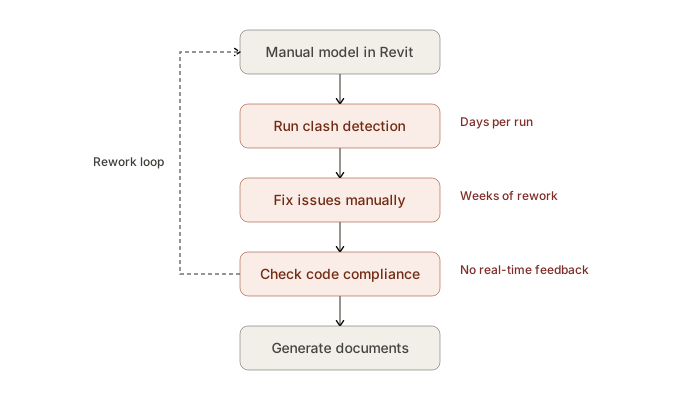
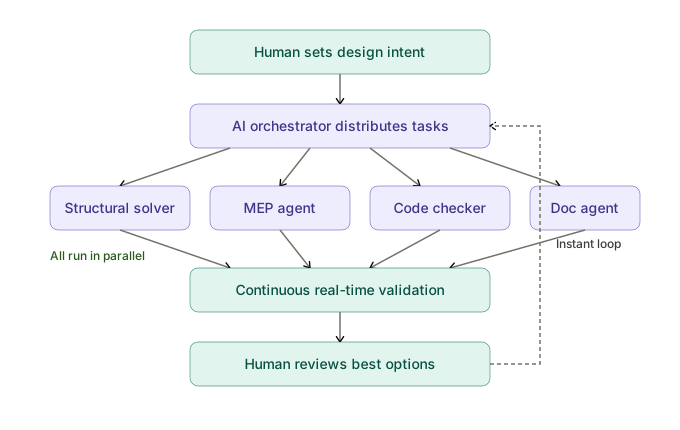
Traditional workflow vs. agentic workflow
Before: sequential, manual
After: parallel, agentic
02
What doesn't work (yet)
Let's be honest. There are things AI doesn't do well in our sector, and it's better to know before investing.
Generative design for structures: demos are impressive. In production, it generates shapes that don't account for real fabrication, transport, or assembly constraints. We're at the very beginning.
Autonomous BIM modelling: "vibe coding" is buzzing, but generating a complete Revit model from a prompt is still far off. AI assists modelling, it doesn't replace it.
AI replacing engineers: professional liability, field judgment, managing the unexpected stay human. And they will. AI amplifies your capacity. Anyone telling you otherwise has never had to sign a compliance report.
Generic chatbots for AEC: ChatGPT without project context is useless for engineering. You need agents connected to YOUR data, YOUR standards, YOUR documents. That's the difference between a tool and a toy.
03
The real shift: agentic BIM
AEC Magazine just dedicated their cover to what they call "the agentic future of BIM." Behind the phrase sits a structural shift in how we design, coordinate, and build.
The concept is simple: instead of a human using software, you have specialized agents (structural, MEP, compliance, documentation) working in parallel on an open data substrate. The human sets the intent, evaluates results, and makes critical decisions. AI handles the repetitive work and coordination.
The MCP (Model Context Protocol) protocol is the bridge that makes this possible. It allows Claude Code to connect directly to Revit, IFC files, and project databases. No more copy-paste, no more export/import: a direct connection between AI and your design data.
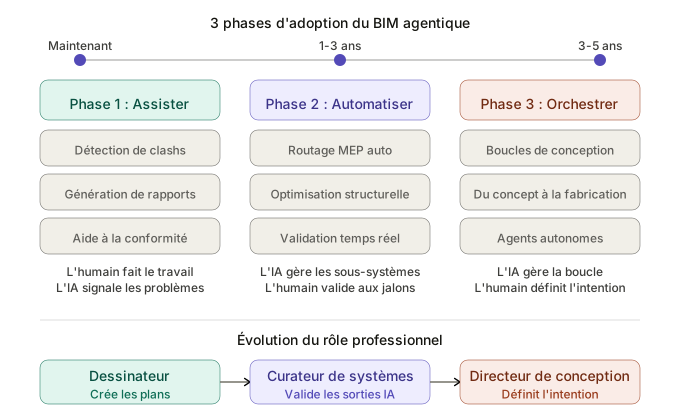
We're in Phase 1. AI assists: it detects problems, generates reports, extracts data. The human still does the work. But those who master this phase now will be the ones leading Phase 2, when AI starts automating entire subsystems.
04
What this means for you
If you're an engineer, BIM manager, technical coordinator, or architect, AI will reach your workflows. Better to be the one who knows how to drive it.
The concrete ROI
- checkDocument analysis: from 4h to 30 minutes per document
- checkSite reports: 2h saved per day
- checkRegulatory compliance: verification in minutes instead of hours
- checkBIM extraction: no more copy-pasting from models
The Deloitte 2026 report on engineering and construction confirms this trend: companies integrating AI into their operational workflows are pulling ahead. Those waiting are losing ground every quarter.
The ASCE survey from December 2025 shows the AEC sector is "slow to adopt AI." The technology is ready. What's missing is a practical, honest guide to get started.
05
Where to start
Don't start by buying a €50k tool. Don't sign a contract with a consulting firm that's never seen a construction site. Start small, on a concrete workflow you know well.
Pick one specific use case: document analysis, site reports, data extraction. One. Not three.
Install Claude Code: documentation is free at docs.anthropic.com. A Claude Pro subscription is enough to start.
Test on a real document: not a fake example. Take the last spec you analyzed, the last report you wrote. Compare the result.
If you want to go faster: the 5-week program condenses 2 years of experimentation into a structured path. You leave with 3 working agents and 4 weeks of field follow-up.
The AEC sector adopts AI slowly because honest guides are rare.
This blog exists to change that. No hype, no "AI revolution," no impossible promises. Field feedback, tested methods, and measurable results, from an engineer who uses these tools every day.